Trompe L'Oeil by Art Effects...
Trompe l'oeil murals are paintings that create
an illusion that fool or trick the eye.
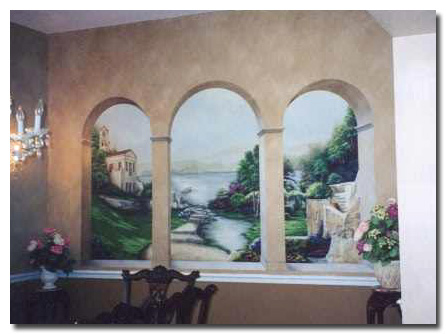
"We Put The Trick, In The Trompe Of Trompe L'Oeil"
Trompe L'Oeil Murals and Art Effects
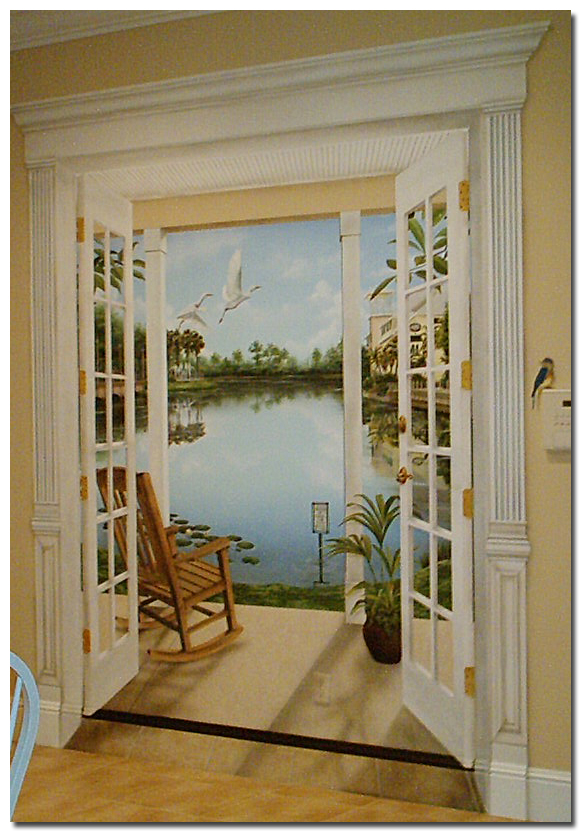
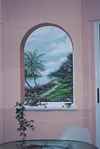
Art Effects' greek window Trompe l'oeil Mural
trompe l'oeil adj :
creating the illusion of seeing
reality; "the visual deception of trompe l'oeil art"
[syn: eye-deceiving,
trompe l'oeil(a)] (Trompe-l'œil),
Throughout this web site you will see murals with
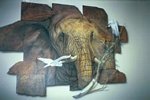
trompe l'oeil effects painted using faux finishes to create
an illusion
that fools or tricks the eye.
Trompe L'Oeil...the name given to the style of painting
which achieves the sense of being three dimensional. In other words the
painted object is suppose to "trick" the viewer into believing the object
is actually real. From the french word Trompe L'Oeil,
pronounced "trum ploy" its meaning translates "to deceive the eye",
literally "to trick the eye" or "to fool the eye". What you see is not always what you get.
Maybe trompe l'oeil can be considered the
decorative artist's ultimate gag or trick,
and trompe l'oeil artists perform these tricks with paint.
"Art Effects... Putting The Trick, In The Trompe Of Trompe L'Oeil"
Along with techniques in faux finishing,
Art Effects uses skills in trompe l'oeil
to create imaginative wall murals in the decorative arts.
Although most of our painted murals and artwork containing
trompe l'oeil are very realistic, realism is not always necessary for a mural
or piece of art to accomplish "The Trick".
In trompe l'oeil the viewer must only be
deceived or tricked for a moment.
Trompe L'Oeil..."To Fool or Trick The Eye"
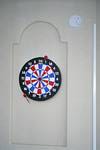
As in our "trompe l'oeil dart board"
for example, one might notice the dart board is actually painted,
disregarding the dart stuck in the wall. Once the trick is realized
and the viewer figures out the dart is painted also,
something so simple becomes entertaining.
In other words the instant the deception
or trick is realized actually becomes more of an impact
than the artwork itself. This is what makes a painting,
a trompe l'oeil...the trick and deception,
the moment the viewer is fooled.
History shows that the Art of Trompe l'oeil Painting
has been used for over two thousand years and as a painting style
dates back to 400 B. C. Although ancient trompe l'oeil works
are lost, descriptions of these paintings have been passed
down through history. Today the earliest murals of trompe l'oeil art
that exist can be found in the ruins of Pompeii and Eurculaneum
and have been dated back to the first century A.D.
After becoming part of the rich culture of the Greek and
Roman Empires, trompe l'oeil art all but disappeared
during the Dark Ages, not to resurface until the Renaissance
and Baroque eras. After the discovery of perspective in the
fifteenth-century, the trompe l'oeil style in mural painting flourished.
Trompe l'oeil artists used these techniques in perspective to create false
openings like doors and windows. In Europe this form of
three dimensional art on a two-dimensional surface
was used extensively by the wealthy and clergy.
Churches and grand cathedrals became a common place for
trompe l'oeil paintings to be used, giving these houses of worship
the appropriate splendor they deserved.
The walls and ceilings of palaces, villas and homes of the rich were
decorated by artists and muralist with trompe l'oeil paintings,
opening the rooms to a grander scale.
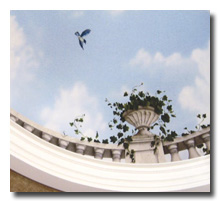
Trompe l'oeil architectural elements,
like columns, pillars and
arches
were painted adding to the richness
and sophistication of their interiors.

Trompe l'Oeil...The Art of Illusionism
Throughout history trompe l'oeil paintings have been more of an
artistic intellectual game then a decoration.
And deception is the object of this game.
Although art styles, like the rules of the game have changed
through the centuries, the name of the game has remained the same...
trompe l'oeil!
Sometimes referred to as illusionism, trompe l'oeil art is an artistic
and visual trick, but should not be confused with
photo realism or counterfeiting. The trick of the trompe
is not accomplished unless the viewer realizes he is being deceived.
So at some point the viewer has to become aware
the trompe l'oeil piece of art is a painting, unlike in a counterfeit,
where the painting is not suppose to be realized it's a fake or faux.
Like counterfeits, realistic renderings and some faux finishes
such as marbles and graining are only successful
if they are not recognized
as being a faux.
Although trompe l'oeil art and a faux painted finish
are closely related, this is a significant difference.
But then the two overlap for example,
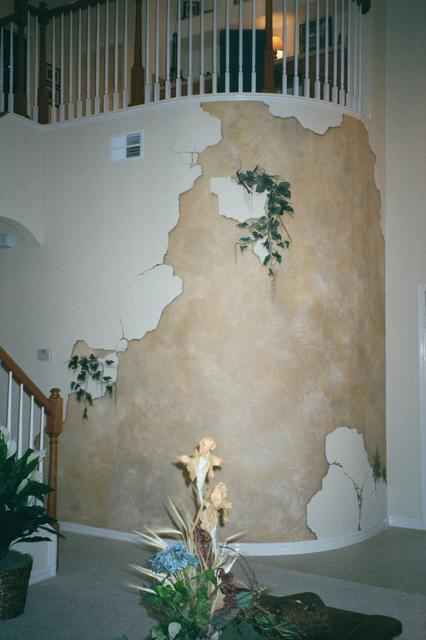
when a faux finish aids in creating an architectural trompe l'oeil painting
with faux textures or other dimensional elements
(Painted Faux Stones)
on the interior or exterior of a building.
Using Trompe L'Oeil
Since paint is most times more economical then the real thing,
trompe l'oeil and faux together are used to create the illusion
of more expensive textured surfaces.
Less expensive, simpler furnishings, along with interiors and exteriors
of buildings can be made to look more expensive
using techniques in wood graining (faux bois)and marbling (faux marbre).
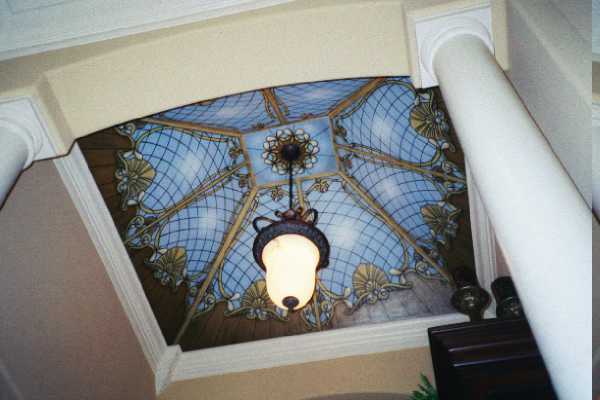
A three dimensional effect can be given to
flat walls and ceilings. With the use of shading,
shadowing and perspective techniques trompe l'oeil
artists and muralists can use their talents to create
windows, doors and other openings
like
break aways, and
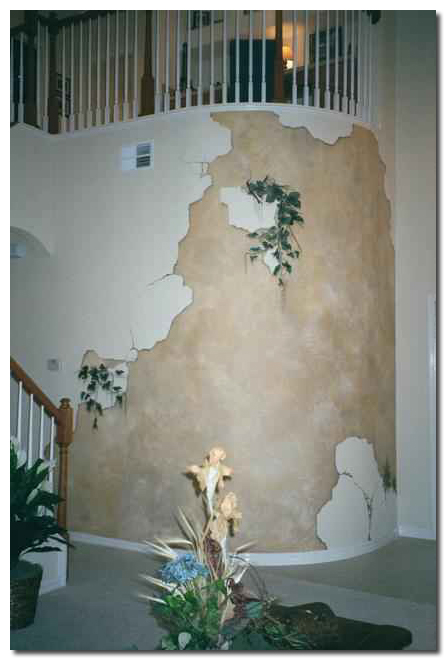
rips and tears to open a room and give it depth.
Tips on Painting Trompe L'Oeil
In order for a trompe l'oeil painting to make the illusion believable
and accomplish the trick, some basic rules have to be followed.
The first concerning
perspective...
trompe l'oeil depends on your perspective,
which means trompes can only
be viewed form one position in order to accomplish the desired effect.
If the viewer moves, the trompe l'oeil painting becomes distorted.
Also when painting trompe l'oeil objects within your mural
make sure that they are completely contained within your
paintings' borders
or extend outside the mural onto the wall (
painting trompe l'oeil outside it's borders)
If something is partially portrayed or cut off it will immediately
give the subject away as a painting and will not trick or fool someone
into believing it is real. Remember you do want the trompe l'oeil
to eventually be recognized as a painting,
but you do need a little time to accomplish the trick.
Some of the easiest things to help in completing your
trompe l'oeil painting are:
Notice the lighting of the room, make sure your shadows,
shading and lighting in the piece of art match the light sources in the room.
Make sure the objects you are painting will not be out of place
in their surroundings
Play close attention to their size, they need
to be life size or at least sized right according to the perspective.
Look through the pages below for
some of our Art Effects...murals, faux finishes with effects and other examples of trompe l'oeil art that fools or tricks the eye.
See Trompe L'Oeil and Murals
Painted by Art Effects,
using faux finishes
to create illusions
and faux effects
in the decorative arts,
throughout this web site.
Find Us Easy at
www.USmurals.com
Bookmark This Site
for future information
and examples of
trompe l'oeil and murals!